New EU Design Legislative Reform Package
First phase comes into force on 1 May 2025
The EU adopted a new Regulation and Directive to modernize EU legislation on designs, which entered into force on 8 December 2024. The aims of these new texts are to strengthen, simplify and harmonize the legal protection of designs across the EU and to adapt EU legislation to the challenges of the era of digital designs and evolving technologies, including 3D printing.
The amendments to the Regulation will apply in two stages, the first phase being applicable from 1 May 2025. Most of the substantial changes will only occur in the second phase, applicable as of 1 July 2026, which will need to be further developed by secondary legislation. All EU member states will then have until 9 December 2027 to transpose the directive into their national legislation.
The key elements of the first phase of changes are:
- New terminology: “European Union Design” or “EU Design” instead of “Community Design”;
- Newly created registration symbol
D
: the holder of a registered EU design will be allowed to use the symbol of the letter D in a circle on his registered design to inform the public that the design is registered.
- Broader definition of 'design': the definition of a design now includes the “movement, transition or any other sort of animation of” the design features. The definition of a design has been updated to take account of technological advances and to offer greater legal certainty as to the types of design that can be protected. In practice -but in the second phase- this will enable more applications to register non-static designs, which is difficult for the time being as the application for registration can only include a maximum of seven representations of the design in the form of static drawings.
- Broader definition of 'product':
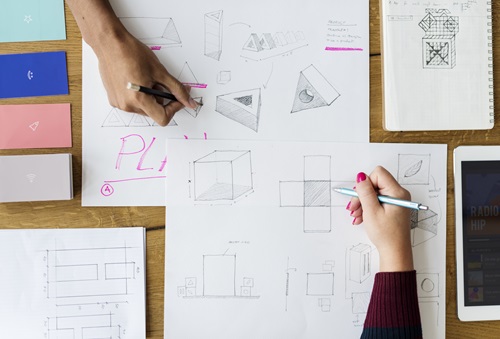
The definition of product has been updated to include industrial or handcraft products, “regardless of whether it is embodied in a physical object or materialises in a non-physical form”. This makes it possible to protect digital objects as designs that only exist in virtual form or even in a virtual environment. Examples of what can constitute a product have also been extended to include spatial arrangement of items intended to form an interior or exterior environment (such as the layout of a store), graphic works, symbols, logos, surface patterns and graphical user interfaces.
- Modernization of the way a design can be represented in the register : “The reproduction may be static, dynamic or animated and shall be effected by any appropriate means, using generally available technology, including drawings, photographs, videos, computer imaging or computer modelling.”. However, it will be necessary to wait for phase 2 before taking real advantage of it. At that time, the seven-view limit will be abolished (the allowed exact number of views will be set out in secondary legislation). The EUIPO is currently studying the technical standards that will apply.
- Extension of the scope of protection of design rights to help combat illegal 3D printing: it will now be an infringement of design rights to create, download, copy and share or distribute to others any medium or software that records the design for the purpose of making a product protected by the design.
- Spare parts / the 'repair clause': the transitional repair clause of the old Design Regulation is turned into a permanent clause. Design protection shall not be conferred to component parts of a complex product upon whose appearance the design of the component part is dependent, and which is used for the sole purpose of the repair of that complex product to restore its original appearance (e.g. bumpers for cars). EU member states who currently provide design protection for spare parts (which is not the case in Benelux), for which registration was applied for before 8 December 2024, can continue to provide this protection until 9 December 2032.
- Visibility requirement for filing:

the design appearance characteristics must be visibly represented in the application for registration. This does not mean that design features of a product need to be visible at all times during the use of the product in order to benefit from design protection. It is about certainty of what is claimed in the application.
- Design protection against counterfeit goods in transit in the EU: the holder of a registered EU design shall be entitled to prevent all third parties from bringing products into the EU even if they are not intended to be placed on the EU market.
- Two new exceptions on monopoly of EU design protection: a third-party may use a registered design (1) if it is necessary to identify or refer to a product as being an original of the right holder and (2) if it is used for the purpose of comment, critique, or parody as long as it is in line with fair trade practices.
- Simplification of the schedule of registration fees and changes to the application and renewal fees for an EU design right: same tax for any additional design regardless of the number, increase of renewal fees, deferment fees to be paid at the time of application filing, abolishment of the publication fee.
- Unity of class abolished: multiple design applications are allowed for different products even if the products do not belong to the same class of the Locarno Classification, allowing a discount on taxes for up to 50 designs.
- Filing date granted only upon payment of the application fee (with a one-month term to regularize it if there are irregularities with the payment).
The European Design system is now in transition. We will inform you of further updates in due course.